
The aviation industry was rocked in late 2024 when Spirit airlines shut down, the pioneer of “Ultra-Low-Cost Carriers” (ULCC) in the United States, officially filed for Chapter 11 bankruptcy protection. For years, Spirit was the go-to for budget travelers, offering “bare fare” tickets that made air travel accessible to millions. However, a perfect storm of legal defeats, engine failures, and shifting consumer habits led to its financial grounding.
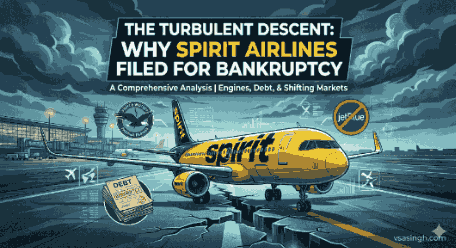
In this deep dive by vsasingh.com, we explore the intricate details of why Spirit Airlines reached this breaking point and what it means for the future of budget travel.
But despite its popularity among cost-conscious travelers, the airline collapsed almost overnight—leaving thousands of passengers stranded and around 17,000 employees affected
Rise of Spirit Airlines
Founded in 1983 (originally as Charter One), Spirit Airlines became one of the pioneers of the ultra-low-cost carrier (ULCC) model.
Key Highlights:
- Offered extremely cheap base fares
- Charged extra for everything (bags, seats, food)
- Focused on budget travelers
This model helped make air travel accessible to millions—but it also made the company vulnerable.
Immediate Cause: Failed $500 Million Bailout
The biggest trigger behind the shutdown was the failure of a government bailout deal.
- A $500 million rescue plan was proposed
- Creditors and political opposition blocked it
- Without funding, Spirit ran out of cash
👉 Result:
The Spirit airlines shut down had no liquidity left to continue operations and was forced to shut down immediately.
The Failed JetBlue Merger: The Fatal Blow
Perhaps the most significant turning point for Spirit was the blocked merger with JetBlue Airways. Spirit had pinned its long-term survival on this $3.8 billion deal.
- The Regulatory Block: In early 2024, a federal judge blocked the merger, citing antitrust concerns. The court argued that the deal would eliminate a key low-cost competitor, leading to higher prices for budget-conscious flyers.
- The Fallout: Once the merger dissolved, Spirit was left without a “Plan B.” It lacked the scale to compete with “The Big Four” (Delta, United, American, and Southwest) and was saddled with massive debt that the merger was supposed to alleviate.
The Pratt & Whitney Engine Crisis
While most airlines faced post-pandemic hurdles, Spirit was uniquely Person with a disability by technical failures.
- Grounded Fleet: A significant portion of Spirit’s Airbus A320neo fleet was grounded due to a rare metal powder contamination in the Pratt & Whitney Geared Turbofan (GTF) engines.
- Operational Strain: At one point, dozens of aircraft were out of service for inspections. This forced Spirit to cancel thousands of flights, resulting in lost revenue and the need to furlough pilots and staff.
Rising Fuel Prices (Major Blow)
One of the most critical reasons was the sharp increase in jet fuel prices.
Why fuel costs surged:
Global oil disruption
Iran-related geopolitical conflict
Supply chain instability
👉 Fuel prices nearly doubled, making operations unsustainable for a low-cost airline.
For an airline like Spirit (which depends on low margins), this was devastating.
Changing Consumer Preferences: The “Premium” Shift
The post-COVID traveler has changed. People are now willing to pay more for comfort, reliability, and “bundled” services.
- The Death of the “Bare Fare”: Spirit’s model relied on charging for everything—from carry-on bags to water. Major airlines countered this by introducing “Basic Economy,” which offered more reliability for a similar price.
- Premium Demand: Travelers increasingly preferred “Premium Economy” or “First Class” experiences, a segment where Spirit had little to offer compared to its competitors.
Intense Price Competition and Oversupply
Ironically, Spirit became a victim of the very low-cost market it helped create.
- Fare Wars: During 2023 and 2024, there was an oversupply of seats in popular leisure markets like Florida and Las Vegas. To fill planes, airlines slashed prices.
- Rising Costs: While ticket prices stayed low due to competition, Spirit’s operating costs—fuel, labor, and maintenance—skyrocketed. The math simply stopped working.
Continuous Financial Losses
Spirit Airlines had been struggling financially for years.
Key facts:
- Lost billions since 2020
- Filed for bankruptcy twice (2024 & 2025)
- No consistent profits post-pandemic
👉 The company was already weak—and external shocks pushed it over the edge.
The Mountain of Debt
Spirit’s balance sheet was a ticking time bomb.
- Loyalty Program Collateral: To stay afloat, Spirit had to use its loyalty program and brand assets as collateral for loans.
- Upcoming Maturities: The airline faced over $1 billion in debt payments due in 2025 and 2026. Without the JetBlue cash infusion, Spirit could not refinance these debts on favorable terms.
Failed JetBlue Merger (Critical Turning Point)
Spirit had planned to merge with JetBlue in a multi-billion-dollar deal.
What happened:
- The merger was blocked in 2024
- Regulators cited antitrust concerns
- Spirit lost a major survival opportunity
👉 Without this merger, Spirit had no strong partner to stabilize its finances.
What Does “Chapter 11” Mean for You?
It is important to note that Spirit Airlines has not “shut down” entirely in the sense of disappearing overnight. Chapter 11 is a “restructuring” bankruptcy.
- Flights Continue: Spirit is still operating flights. If you have a booking, it remains valid for now.
- Restructuring: The goal is to wipe out some debt, streamline the fleet, and emerge as a smaller, more efficient airline.
- Job Cuts: Unfortunately, part of this process involves cutting routes that aren’t profitable and reducing staff numbers to save costs.
Global Economic Pressure
Global factors also played a major role:
- Inflation increased operational costs
- Labor costs rose
- Currency fluctuations impacted revenue
👉 Combined effect = unsustainable cost structure
Impact of the Shutdown
Employees
- ~17,000 jobs affected
- Sudden unemployment crisis
Passengers
- Thousands stranded
- Refund process delayed
Industry
- Reduced competition
- Ticket prices may increase
👉 Budget travel options will likely shrink.
Who Benefits?
After Spirit’s collapse:
- Major airlines gain more control
- Competitors may raise prices
- Low-cost market becomes less competitive
Future of Low-Cost Airlines
Spirit’s shutdown raises serious questions:
Will ULCC model survive?
- Yes, but with changes
- More focus on customer experience
- Better pricing transparency
Key Lessons from Spirit Airlines Collapse
- Low prices alone are not enough
- Financial stability is critical
- Adaptation to market changes is necessary
- Strong partnerships matter
- External risks (fuel, war, economy) can destroy businesses
Conclusion
The struggles of Spirit airlines shut down signal a massive shift in the aviation world. The era of ultra-cheap, “no-frills” flying is being replaced by a demand for value and reliability. For vsasingh.com, we see this as a lesson in business adaptability: even the most disruptive models must evolve to survive.







Leave a Reply