
In the grand cosmic order of Sanatana Dharma, no sacred ritual, spiritual journey, or auspicious worldly venture begins without invoking the divine name of Lord Ganesha. He is the Supreme Vighnaharta (the Remover of Obstacles), Prathameshvara (the First-Worshiped Deity), and the ultimate source of Buddhi (intellect), Siddhi (spiritual attainment), and Riddhi (prosperity).
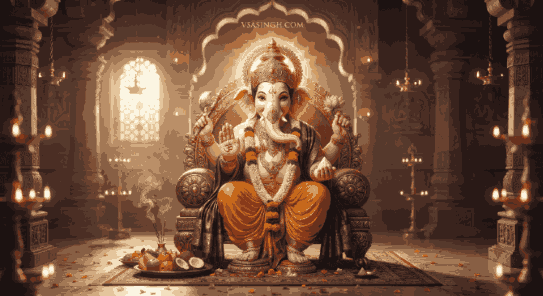
For thousands of years, Lord Ganesha has stood at the nexus of Indian spiritual philosophy, art, literature, and social unity. From ancient Vedic chants to the vibrant public celebrations of modern India, Ganesha worship embodies the harmonious synthesis of divine wisdom, natural living, and community brotherhood.
This comprehensive guide, published by vsasingh.com, explores the profound Vedic lore, historical transformation, philosophical symbolism, Sanskrit hymns, and ritual traditions surrounding Lord Ganesha.
Sacred Sanskrit Hymns and Philosophical Foundations (श्रीगणेश स्तोत्राणि)
The true essence of Lord Ganesha is captured through the timeless vibrations of Sanskrit mantras. In Sanatana theology, sound (Shabda) is primordial energy, and the name of Ganesha is synonymous with the cosmic sound of Om (ॐ).
Ganesha Dhyana Mantra (ध्यान मन्त्रम्)
शुक्लांबरधरं विष्णुं शशिवर्णं चतुर्भुजम्।
प्रसन्नवदनं ध्यायेत् सर्वविघ्नोपशान्तये॥
- Literal Translation:
“We meditate upon Lord Ganesha, who wears pure white garments, who is all-pervading like the moon, who possesses four divine arms, and who wears a serene, joyful countenance, to eradicate all impediments and obstacles from our path.”
Vakratunda Mahakaya Mantra (वक्रतुण्ड महाकाय मन्त्रम्)
वक्रतुण्ड महाकाय सूर्यकोटि समप्रभ।
निर्विघ्नं कुरु मे देव सर्वकार्येषु सर्वदा॥
- Literal Translation:
“O Lord with the curved trunk, massive cosmic form, and brilliance equaling ten million suns! Please make all my endeavors free from obstacles, always and everywhere.”
Ganesh Gayatri Mantra (गणेश गायत्री मन्त्रम्)
एकदन्ताय विद्महे वक्रतुण्डाय धीमहि।
तन्नो दन्तिः प्रचोदयात्॥
- Literal Translation:
“May we realize the single-tusked divinity; may we meditate upon the Lord with the curved trunk. May that divine Lord with the tusk illuminate our intellect and lead us toward supreme consciousness.”
History of Ganesh Utsav in India: From Vedic Origins to Public Movement
While individual and royal worship of Lord Ganesha has existed since time immemorial, the tradition of public Sarvajanik Ganesh Utsav has a fascinating socio-historical evolution in India.
+-----------------------------------------------------------------------------------------+
|                              CHRONOLOGY OF GANESH FESTIVAL                              |
+-----------------------------------------------------------------------------------------+
| Ancient Era   : Vedic & Puranic Roots                                                   |
|                 - Invocation in Rigveda (2.23.1) as Brahmanaspati / Ganapati.           |
|                                                                                         |
| Maratha Era   : 1630s–1680s                                                             |
|                 - Initiated as a public festival by Chhatrapati Shivaji Maharaj in Pune. |
|                                                                                         |
| Peshwa Era    : 18th Century                                                            |
|                 - Patronized as the official royal state festival at Shaniwar Wada.    |
|                                                                                         |
| Modern Revival: 1893 CE                                                                 |
|                 - Transformed by Lokmanya Bal Gangadhar Tilak into a mass freedom effort.|
+-----------------------------------------------------------------------------------------+
A. Vedic and Antiquity Roots
The earliest seeds of Ganesha worship are traced back to the Rigveda (Mandala 2, Sukta 23, Mantra 1):
गणानां त्वा गणपतिं हवामहे कविं कवीनामुपमश्रवस्तमम्।
ज्येष्ठराजं ब्रह्मणां ब्रह्मणस्पत आ नः शृण्वन्नूतिभिः सीद सादनम्॥
Here, the Lord is invoked as Ganapati—the leader of divine assemblies and the supreme custodian of sacred mantras. Over centuries, texts like the Ganesha Purana, Mudgala Purana, and Ganapati Atharvashirsha expanded His divine theology as the Nirguna-Brahman (formless ultimate reality) taking a Saguna (manifested) form for the protection of the universe.
B. The Maratha and Peshwa Patronage
In the 17th century, Chhatrapati Shivaji Maharaj, the great founder of the Maratha Empire, popularized Ganesh Utsav as a public cultural event in Pune. It served as a means to promote cultural pride, moral courage, and spiritual strength among his people.
Later, during the 18th century, the Peshwas—who held Lord Ganesha as their family deity (Kuladevata)— elevated the festival to a grand state celebration at Shaniwar Wada. However, after the fall of the Peshwa rule in 1818, the grand celebrations largely returned to private home rituals.
C. The Historic Revival of 1893: Lokmanya Bal Gangadhar Tilak
During the late 19th century, under British colonial rule, public gatherings were strictly banned under sedition laws. Nationalist leader, scholar, and social reformer Lokmanya Bal Gangadhar Tilak identified Lord Ganesha as a universal deity worshiped across all castes, social strata, and sects.
In 1893, in Pune (starting from Kesari Wada and Bhausaheb Rangari Ganpati), Tilak transformed domestic Ganesh worship into the grand Sarvajanik (Public) Ganesh Utsav.
Key Strategic Aims of Tilak’s Movement:
- National Unity: Circumvented British bans on political assemblies by converting spiritual gatherings into platforms for social discussions.
- Swadeshi & Cultural Awakening: Promoted local artisans, traditional music, Marathi theater, and nationalistic poetry.
- Eradication of Social Barriers: Brought people of all castes together under one pandal to share prayers, meals, and cultural activities.
Esoteric Symbolism of Lord Ganesha’s Form
Every physical attribute of Lord Ganesha carries deep Vedantic meaning, acting as a guidebook for human self-improvement and spiritual evolution.
[ Big Head: High Intellect & Wisdom ]
[ Small Eyes: Focus & Detail ] -+- [ Large Ears: Listen More ]
[ Single Tusk: Sacrifice & Single-Mindedness ]
[ Curved Trunk: Adaptability & Efficiency ]
[ Large Stomach: Digest All Good & Bad in Life ]
[ Mouse (Vahana): Control Over Ego & Desires ]
- Large Elephant Head (Gajanana): Represents supreme wisdom, vast intellectual capacity, and expansive spiritual awareness.
- Small Eyes: Symbolizes intense concentration, attention to detail, and a sharp spiritual vision capable of looking beyond worldly illusions (Maya).
- Large Ears (Shoorpakarna): Represents the virtue of listening more than speaking (Sravana), signifying patience and receptivity to prayers and knowledge.
- Single Tusk (Ekadanta): Symbolizes non-duality (Advaita) and self-sacrifice. According to legend, Ganesha broke His own tusk to write the epic Mahabharata dictated by Sage Vyasa without interruption.
- Curved Trunk (Vakratunda): Demonstrates high adaptability, efficiency, and the ability to master both macro-cosmic challenges and micro-level tasks.
- Large Abdomen (Lambodara): Symbolizes the capacity to peacefully digest all life experiences—both pleasant and unpleasant—without losing equanimity.
- The Mouse Vahana (Mushaka): Represents the restless human mind and desires. Ganesha riding the mouse signifies total mastery over ego, greed, and earthly desires.
4. Sacred Names of Lord Ganesha (अष्टोत्तर शतनामवली Highlights)
The sacred scriptures record 108 names for Lord Ganesha. Below are twelve prominent names (Dwadasa Namani) along with their spiritual meanings:
| # | Name | Sanskrit Chant | Divine Significance |
| 1 | Sumukha | Om Sumukhaya Namah | The One with a auspicious, charming, and peaceful face. |
| 2 | Ekadanta | Om Ekadantaya Namah | The One who possesses a single tusk, representing non-duality. |
| 3 | Kapila | Om Kapilaya Namah | The Lord of reddish-brown golden hue, symbolizing divine brilliance. |
| 4 | Gajakarnaka | Om Gajakarnakaya Namah | The One with elephant-like ears that filter divine wisdom. |
| 5 | Lambodara | Om Lambodaraya Namah | The One with a large belly housing all universe’s creation. |
| 6 | Vikat | Om Vikataya Namah | The Formidable and Mighty Destroyer of negative energies. |
| 7 | Vighnanasha | Om Vighnanashaya Namah | The Eradicator of all material and spiritual obstacles. |
| 8 | Vinayaka | Om Vinayakaya Namah | The Supreme Ruler and Peerless Leader of all beings. |
| 9 | Dhumraketu | Om Dhumraketuye Namah | The Lord of smoky color who destroys evil forces in Kaliyuga. |
| 10 | Ganadhyaksha | Om Ganadhyakshaya Namah | The Chief of all celestial ganas (groups of entities). |
| 11 | Bhalachandra | Om Bhalachandraya Namah | The One who wears the cool crescent moon on His forehead. |
| 12 | Gajanana | Om Gajananaya Namah | The Lord who possesses the elephant head. |
Eight Divine Avatars of Ganesha (Mudgala Purana)
The Mudgala Purana describes eight important avatars of Lord Ganesha, each representing the victory of divine wisdom over a particular negative quality or demon. These forms teach devotees about removing obstacles, controlling ego and overcoming inner weaknesses.
- Vakratunda – Conquers Matsaryasura (jealousy).
- Ekadanta – Conquers Madasura (pride and arrogance).
- Mahodara – Conquers Mohasura (delusion).
- Gajavaktra – Conquers Lobhāsura (greed).
- Lambodara – Conquers Krodhasura (anger).
- Vikata – Conquers Kamasura (desire).
- Vighnaraja – Conquers Mamasura (ego and possessiveness).
- Dhumravarna – Conquers Ahamkarasura (egoism).
Ashta Vinayaka Temples of Maharashtra
The Ashta Vinayaka, meaning “Eight Ganesha forms,” refers to eight highly revered temples dedicated to Lord Ganesha in Maharashtra. These temples are connected with different legends and divine manifestations of Lord Ganesha. The traditional pilgrimage covers Morgaon, Siddhatek, Pali, Mahad, Theur, Lenyadri, Ozar, and Ranjangaon. Devotees visit these sacred temples to seek blessings, wisdom, prosperity, and the removal of obstacles.
The eight Ashta Vinayaka names are:
- Mayureshwar – Morgaon
- Siddhivinayak – Siddhatek
- Ballaleshwar – Pali
- Varadvinayak – Mahad
- Chintamani – Theur
- Girijatmaj – Lenyadri
- Vighneshwar – Ozar
- Mahaganapati – Ranjangaon
The Ashta Vinayaka pilgrimage is an important part of Maharashtra’s rich Hindu religious tradition and Ganesh devotion.
The Story of Durva Grass & Modak
According to Hindu tradition, Durva grass and Modak are two sacred offerings closely associated with Lord Ganesha. Durva, a small green grass usually offered in bunches, is believed to please Ganesha and symbolizes purity, prosperity, and devotion. One popular legend says that Durva helped calm the intense heat of Ganesha after he defeated the demon Analasura.
Modak is considered Lord Ganesha’s favorite sweet. The traditional story says that Modak represents knowledge, wisdom, and spiritual bliss hidden within its sweet outer covering. Devotees especially offer Modaks during Ganesh Chaturthi, believing that sincere prayers and offerings bring Ganesha’s blessings and help remove obstacles from life.
Durva and Modak together symbolize devotion, wisdom, purity, and divine blessings.
Global Traditions of Ganesha Worship
Lord Ganesha is worshipped not only in India but also in many parts of the world. His image represents wisdom, prosperity, good fortune, and the removal of obstacles. In countries with Indian communities, festivals such as Ganesh Chaturthi are celebrated with prayers, devotional songs, processions, and cultural programs.
In Mauritius, Fiji, Nepal, Singapore, Malaysia, the United Kingdom, the United States, Canada, and Australia, Ganesha worship has become an important part of Hindu cultural traditions. Temples and community groups organize special pujas and celebrations, bringing families and devotees together.
Ganesha is also admired beyond Hindu communities as a symbol of knowledge, success, and new beginnings. His universal message of overcoming difficulties and seeking wisdom continues to inspire people across different cultures
Famously Iconic Pandals of India
India is known for its grand and artistic Ganesh pandals, especially during Ganesh Chaturthi. These temporary structures attract thousands of devotees and visitors with their beautiful decorations, creative themes, massive idols, and cultural performances.
Mumbai is particularly famous for iconic pandals such as Lalbaugcha Raja, GSB Sarvajanik Ganpati, and Andhericha Raja. In Pune, traditional celebrations at Dagdusheth Halwai Ganpati are among the most popular. Other cities across Maharashtra and different parts of India also create unique pandals inspired by temples, social themes, historical monuments, and current issues.
These pandals are more than places of worship—they combine faith, art, community spirit, and creativity. Every year, devotees look forward to new themes and spectacular decorations, making Ganesh Chaturthi one of India’s most visually celebrated festivals.
Step-by-Step Home Visarjan Vidhi
Home Ganesh Visarjan can be performed with devotion and simple traditional rituals. First, clean the worship area and offer flowers, Durva grass, Modak, fruits, incense, and aarti to Lord Ganesha. Pray sincerely and thank Bappa for being welcomed into your home.
Next, perform the final aarti and seek blessings for your family. Recite prayers and ask Lord Ganesha to return again next year. Carefully lift the idol and carry it to a clean container or suitable home immersion setup.
Place the idol gently in the water and chant “Ganpati Bappa Morya, Pudchya Varshi Lavkar Ya!” After the immersion, offer a final prayer and maintain cleanliness by disposing of flowers and other पूजा materials responsibly.
Home visarjan is ultimately about faith, gratitude, devotion, and respect for nature.
Eco-Friendly Ganesha & Modern Sustainability
Eco-Friendly Ganesha celebrations are becoming increasingly popular as devotees look for ways to protect nature while honoring Lord Ganesha. Shadu clay idols are made from natural clay and are considered a more environmentally friendly option than idols made with non-biodegradable materials.
Another creative idea is plantable Ganesha idols, which contain seeds inside the idol. After immersion, the dissolved clay can help the seeds grow into plants, turning devotion into a symbol of new life.
Many communities also promote artificial ponds for Ganesha immersion. These specially created ponds can reduce the pressure on rivers, lakes, and other natural water bodies. Choosing natural decorations, reducing plastic, and using eco-friendly colors can further support a greener celebration.
Celebrate Ganpati with faith, joy, and care for Mother Nature. 🌱🙏
Essential Rituals of Ganesh Chaturthi (पूजा विधि)
The traditional celebration of Ganesh Chaturthi spans 10 to 11 days, beginning on Bhadrapada Shukla Chaturthi and culminating on Anant Chaturdashi.
The Core Ritual Steps:
- Avahana & Pranapratishtha (आवाहन एवं प्राणप्रतिष्ठा):
The invocation ritual where sacred Sanskrit mantras are recited to invite the divine consciousness into the clay idol (Murti). - Shodashopachara Puja (षोडशोपचार पूजा):
A formal 16-step worship offering sandalwood paste (Chandan), kumkum, red hibiscus flowers (Jaba Kusum), and Durva grass (a special 21-blade bundle sacred to Ganesha). - Naivedya Offering (नैवेद्यम्):
Offering Lord Ganesha’s favorite sweets—especially 21 Modakas (steamed sweet dumplings filled with coconut and jaggery), Laddus, and fresh fruits. - Ganesh Aarti (आरती):
Performing the daily lighting of lamps while chanting classic devotional hymns like “Sukhakarta Dukhaharta” (written by Samarth Ramdas Swami). - Uttarpuja & Visarjan (उत्तरपूजा एवं विसर्जन):
Uttarpuja & Visarjan (उत्तरपूजा एवं विसर्जन) marks the ceremonial farewell to Lord Ganesha. Devotees perform the final prayers, offer flowers and sweets, and seek Bappa’s blessings before carrying the clay idol in a joyful procession. Dhol-tasha beats, devotional songs, and chants of “Ganpati Bappa Morya, Pudhchya Varshi Lavkar Ya!” fill the atmosphere with devotion and celebration. - Families and communities often choose suitable water bodies or designated immersion areas for the final ritual. The ceremony also reflects an important Vedantic idea: everything that comes from the earth eventually returns to nature. The cycle of creation, dissolution, and renewal reminds devotees about the temporary nature of life and the eternal flow of the universe.
Conclusion
Lord Ganesha represents the perfect harmony between nature, intellect, devotion, and social harmony. He teaches us to overcome life’s obstacles with wisdom, to remain rooted in humility despite possessing supreme knowledge, and to live in unity with all of creation.
As we celebrate Ganesh Utsav, let us embody the spiritual values He represents—wisdom, righteousness, patience, and universal goodwill..

Leave a Reply