
Traditional fashion has always had a special place in Indian photography. Whether it is a beautiful saree, a graceful lehenga, an ethnic suit, or a simple traditional outfit, the right styling can completely change the mood of a photograph. Now, with Traditional Outfit Photo Prompts AI image generators and photo editing tools, creating these kinds of portraits has become much easier.
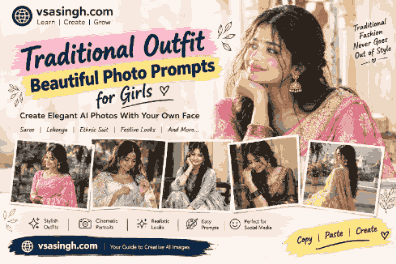
At vsasingh.com, we regularly explore creative viral traditional Outfit AI photo prompts that can help beginners turn simple ideas into detailed and realistic images. In this guide, we are sharing a collection of Traditional Outfit Beautiful Photo Prompts for Girls that you can use with popular AI image-generation and photo-editing tools.
The main idea is simple: upload your reference photo, describe the traditional outfit and photography style you want, and let the AI create a new visual while keeping your facial identity as close to the reference as the selected tool allows.
You can experiment with a pink saree, cream-white lehenga, Banarasi silk saree, ethnic suit, Maharashtrian-inspired styling, festive fashion, wedding-inspired portraits, or a simple indoor traditional look.
These prompts are written in a way that makes them easy to copy, customize, and understand. You do not need to be an expert in traditional outfit photo editing Prompts . Just change the outfit, color, background, jewelry, lighting, or camera style according to your preference.
Important: AI tools can interpret identity and facial details differently. Instead of expecting an exact result every time, use a clear reference image and repeat the identity-preservation instructions when necessary.
What Are Traditional Outfit AI Photo Prompts?
A traditional outfit AI photo prompts is a detailed text instruction that tells an AI image generator how you want a picture to look.
For example, instead of simply writing:
“Create a girl wearing a saree.”
you can describe the complete scene:
- outfit color and fabric
- hairstyle
- jewelry
- makeup
- pose
- facial expression
- background
- lighting
- camera perspective
- image ratio
- photography style
- realism level
The AI then uses these instructions to create an image based on the description.
This makes prompts especially useful for people who want more control over the final result.
A detailed prompt can help you create a traditional fashion portrait that feels more personalized rather than looking like a generic Indian traditional AI photo prompts.
Why Traditional AI Photos Are Trending
Traditional fashion photographs work particularly well with AI because there are many visual elements that can be described clearly.
A saree has its own texture, folds, border, and draping style. Jewelry can add another layer of detail. Background lighting can completely change the atmosphere. Even a simple change from a cream background to a warm festive environment can produce a different visual mood.
For social media creators, these images can be useful for:
- Instagram posts
- Facebook posts
- Pinterest graphics
- profile pictures
- festival posts
- fashion inspiration
- traditional outfit ideas
- digital wallpapers
- AI photography experiments
- personal creative projects
The best part is that you can create several variations from one concept.
For example, the same reference photo can be transformed into a pink Banarasi saree portrait, a cream lehenga editorial, or an elegant ethnic indoor photograph.
How to Use These Traditional Outfit Prompts
Before using any prompt, choose a clear reference photograph.
A front-facing or slightly angled image with good lighting usually gives an AI tool more information about the person’s facial features.
Step 1: Select a Clear Photo
Choose a photo where the face is visible and not heavily covered by sunglasses, hands, filters, or extreme shadows.
Step 2: Upload the Reference Image
Open the AI image generator or image-editing application that supports reference images.
Step 3: Paste the Prompt
Copy one of the prompts below and add your preferred changes.
Step 4: Customize the Outfit
You can change:
- pink to red
- silk to chiffon
- saree to lehenga
- gold jewelry to silver jewelry
- indoor background to outdoor background
- warm lighting to natural daylight
Step 5: Generate and Compare
AI image generation is often experimental. If the first result is not exactly what you imagined, make small changes rather than completely changing the prompt.
Pink Banarasi Saree Traditional Portrait
Pink is one of the most versatile colors for traditional fashion photography. It can look soft, festive, elegant, and luxurious depending on the lighting and jewelry.
Use this prompt for a premium pink saree portrait:
Create an ultra-realistic traditional fashion portrait using the uploaded reference image of the same person.

Preserve the person's recognizable facial identity and natural facial proportions. Keep the facial structure, eyes, eyebrows, nose, lips, jawline, skin tone and overall appearance consistent with the reference image. Do not unnecessarily change the person's identity.

Dress her in an elegant blush-pink Banarasi silk saree with a delicate antique-gold woven border and naturally flowing fabric folds. Add a matching traditional blouse with subtle embroidery.

Style the hair in soft natural waves with a clean middle part and a few loose strands around the face. Add a small traditional bindi.

Include elegant pearl and gold jewelry, delicate earrings, a refined necklace, traditional bangles and a few simple rings.

Use soft warm indoor lighting with a subtle golden glow. Keep the background minimal with cream and beige tones and gentle depth.

The photograph should look like a professionally captured fashion portrait while retaining realistic skin texture, natural facial details, believable fabric texture and authentic jewelry reflections.

Photorealistic photography, natural expression, realistic skin pores, detailed silk fabric, soft shadows, realistic eyes, subtle highlights, premium ethnic fashion photography.

Aspect ratio: 4:5
This version is suitable when you want a traditional but modern Instagram-style portrait.
Pink Saree Selfie Style
If you prefer a more casual photograph instead of a professional studio portrait, try a smartphone-style composition.
Create a realistic smartphone selfie portrait using the uploaded reference image as the identity reference.

Keep the person's recognizable facial features and natural proportions consistent with the reference image.

Dress her in a beautiful soft pink silk saree with a subtle gold border and matching blouse. The saree should have realistic folds and a natural drape.

Add a small black bindi, soft wavy dark hair, delicate gold earrings, a pearl necklace and traditional bangles.

Create a cozy indoor environment with cream-colored walls and warm household lighting.

The photograph should look like a genuine smartphone photograph rather than a heavily edited fashion campaign.

Use realistic front-camera perspective, natural skin texture, slight lens imperfections, subtle image grain and believable indoor exposure.

Expression should be calm and natural with a gentle smile.

Aspect ratio: 9:16.
This style works especially well for vertical social-media images.
Cream and White Lehenga Look
A cream or off-white traditional outfit can create a completely different visual mood from a bright saree.
Create a premium photorealistic ethnic fashion portrait using the uploaded reference photo.

Maintain the person's recognizable identity and natural facial proportions.

Dress her in an elegant cream-white traditional lehenga featuring delicate embroidery, subtle golden threadwork and realistic flowing fabric.

Add a matching blouse and lightweight dupatta placed naturally over one shoulder.

Use soft traditional jewelry including a delicate necklace, statement earrings, slim bangles and a small maang tikka.

Hair should be naturally wavy and styled in an elegant traditional manner with a few loose strands framing the face.

Use warm golden indoor lighting with a softly blurred beige background.

The image should resemble a professionally photographed Indian ethnic fashion portrait.

Natural skin texture, realistic fabric, believable jewelry reflections, soft shadows, detailed embroidery, realistic eyes and subtle cinematic depth.

Avoid excessive skin smoothing, artificial facial changes, plastic-looking skin and unrealistic body proportions.

Aspect ratio: 4:5.
Traditional Maharashtrian-Inspired Portrait
For users who want a regional traditional fashion aesthetic, you can introduce cultural styling through jewelry and accessories.
Create a realistic traditional Indian fashion portrait using the uploaded reference image.

Preserve the recognizable facial identity and natural appearance of the person.

Style her in an elegant traditional saree with rich fabric texture and a refined border.

Add a traditional Maharashtrian-inspired nose ring, statement earrings, necklace, bangles and a delicate forehead accessory.

Keep the makeup soft and natural with warm eyeshadow, subtle blush and a natural lip color.

Style the hair neatly with soft waves and traditional detailing.

Use warm window light entering from one side, creating gentle highlights on the face and jewelry.

Background should be a simple warm beige indoor environment with subtle depth and no distracting objects.

The final image should look like authentic professional ethnic photography with realistic skin, fabric and jewelry.

Aspect ratio: 4:5.
This prompt can be modified according to the specific regional style you want to explore.
Traditional Festive Outfit
Festivals are another great theme for AI traditional portraits.
Generate a photorealistic festive traditional portrait from the uploaded reference image.

Keep the person's recognizable facial identity and natural facial proportions consistent with the reference.

Dress her in an elegant festive Indian outfit with rich fabric, detailed embroidery and tasteful traditional colors.

Add delicate gold jewelry, earrings, bangles and a small traditional bindi.

Use warm festive lighting with subtle decorative lights in the background.

The background should contain soft glowing lights and a tasteful Indian festive atmosphere without becoming crowded.

Expression should be natural, happy and relaxed.

Create realistic skin texture, natural hair strands, detailed clothing, authentic jewelry reflections and believable depth.

Avoid excessive beauty filters or artificial facial modifications.

Professional ethnic photography, warm color palette, realistic lighting, high detail.

Aspect ratio: 4:5.
Luxury Traditional Fashion Editorial
For a more premium magazine-style appearance, use an editorial approach.
Create a luxury ethnic fashion editorial portrait using the uploaded reference photograph.

Preserve the recognizable identity of the person while maintaining natural facial proportions.

Dress her in an elegant traditional Indian outfit featuring premium fabric, intricate embroidery and refined traditional styling.

Use sophisticated gold jewelry with a matching necklace and earrings.

Hair should have natural volume and elegant styling.

Use controlled warm window lighting with soft shadows and realistic highlights.

The background should be minimal, elegant and neutral, resembling a premium fashion studio.

Use realistic photography characteristics, detailed skin texture, accurate fabric folds, natural eyes, believable jewelry reflections and professional composition.

The final image should feel like a high-end Indian fashion magazine photograph rather than a digital illustration.

Aspect ratio: 4:5.
Close-Up Traditional Beauty Portrait
Sometimes you do not need a full-body image. A close-up can make jewelry, makeup, and facial expression the main focus.
Create an ultra-realistic close-up traditional beauty portrait using the uploaded reference image.

Preserve the person's recognizable identity, natural facial structure, eye shape, nose, lips, eyebrows and skin tone.

Dress her in an elegant traditional outfit visible around the shoulders and neckline.

Add a small bindi, delicate earrings and a refined traditional necklace.

Use soft warm window lighting from one side.

Focus on realistic eyes, natural skin texture, subtle facial details and individual hair strands.

Keep makeup elegant and understated.

Use a softly blurred cream-colored background.

Professional ethnic beauty photography, realistic lens rendering, natural skin, soft highlights, realistic shadows and premium editorial quality.

Aspect ratio: 4:5.
Traditional Saree Side Profile
Side-profile photographs can highlight jewelry, hairstyle and saree details.
Create a photorealistic traditional side-profile portrait using the uploaded reference image.

Keep the person's recognizable facial identity and natural proportions consistent with the reference.

Dress her in a beautiful traditional saree with an elegant blouse and detailed border.

Style the hair naturally and tuck part of it behind one ear.

Add traditional earrings, a delicate necklace, bangles and a small bindi.

Capture a natural 45-degree side profile with a relaxed expression.

Use warm window lighting that creates soft highlights along the cheek, jawline and hair.

Background should be minimal cream and beige with subtle depth.

Show realistic fabric texture and jewelry reflections.

Avoid excessive retouching and artificial skin smoothing.

Photorealistic DSLR-style ethnic portrait.

Aspect ratio: 4:5.
Simple Traditional Outfit
Not every traditional photograph needs heavy jewelry or dramatic lighting. Sometimes simplicity produces a more natural result.
Create a natural-looking traditional Indian portrait using the uploaded reference photo.

Preserve the person's recognizable facial identity and natural appearance.

Dress her in a simple elegant traditional outfit with soft fabric and minimal embroidery.

Use only delicate earrings, a small bindi and a few simple bangles.

Keep the hairstyle natural with loose dark hair.

Use soft daylight coming through a nearby window.

Place her against a simple cream-colored wall.

The photograph should feel like a genuine personal portrait captured at home.

Natural skin texture, realistic hair, authentic clothing folds, soft shadows and subtle color grading.

Avoid excessive makeup, heavy filters and artificial effects.

Aspect ratio: 4:5.
How to Make the Pink Saree Look More Realistic
If you are specifically creating a pink saree AI photo, the fabric description matters.
Instead of simply writing “pink saree,” try describing the material.
For example:
- blush pink Banarasi silk
- dusty rose silk saree
- pastel pink organza saree
- rose-pink chiffon saree
- deep pink silk saree
- pink saree with antique-gold border
- soft rose saree with zari detailing
You can also describe how the fabric should behave.
For example:
The saree should have naturally falling folds, realistic silk reflections, subtle fabric creases and a believable drape around the body.
This gives the AI more visual information.
Choosing the Right Jewelry
Jewelry can completely change the personality of a traditional photograph.
For a minimal look, use:
- small earrings
- thin bangles
- simple necklace
- tiny bindi
festive look:
- jhumka earrings
- layered necklace
- gold bangles
- maang tikka
For a Maharashtrian-inspired look:
- nath
- traditional earrings
- necklace
- bangles
- forehead jewelry
The important point is not to overload every image with accessories.
A good prompt should match the jewelry with the outfit.
How to Keep the Face Consistent
One of the most common problems with AI photo editing is that the generated face may look different from the reference.
If your selected tool supports image references, upload a clear photo and include an identity instruction.
You can use wording such as:
Use the uploaded image as the primary identity reference. Preserve the person's recognizable facial structure and natural proportions. Keep the eyes, eyebrows, nose, lips, jawline, skin tone and overall identity consistent with the reference.
You can also add:
Do not unnecessarily redesign or replace the person's facial features.
However, it is important to understand that the phrase “100% face same” does not guarantee an exact result. Different AI systems have different identity-preservation capabilities.
A clearer reference image generally gives the model more useful information.
Best Background Ideas for Traditional AI Photos
The background should support the outfit instead of competing with it.
Here are some ideas you can add to your prompts:
Cream Wall
A simple cream wall is ideal for clean portraits.
Traditional Interior
You can describe a warm Indian interior with subtle decorative elements.
Festive Lights
Soft glowing lights can create a celebration-inspired atmosphere.
Window Light
Natural window light gives a softer and more realistic appearance.
Outdoor Garden
A quiet garden can work well with pastel traditional outfits.
Heritage Architecture
Traditional architecture can create a richer cultural atmosphere.
When using a detailed outfit, avoid adding too many background objects.
Lighting Makes a Big Difference
Lighting is one of the most important parts of an AI photography prompt.
For a soft traditional portrait, try:
Warm window light
For a festive photograph:
Golden decorative lighting
For a premium editorial look:
Soft directional studio-style light
For a casual photo:
Natural indoor daylight
For an evening mood:
Warm ambient lamp lighting
You can even combine natural and artificial light:
Soft daylight from the window combined with subtle warm indoor ambient light.
This can produce a balanced and believable environment.
Camera Style for More Realistic Results
Adding camera information can sometimes help establish a photographic aesthetic, although AI tools do not necessarily reproduce technical camera settings literally.
You can mention:
- DSLR photography
- professional portrait lens
- smartphone photography
- 85mm portrait style
- natural depth of field
- front-camera selfie
- editorial fashion photography
For a close portrait, you might write:
Professional portrait photography with a natural shallow depth of field and realistic lens rendering.
For a smartphone look:
Natural smartphone photography with authentic handheld framing and subtle camera imperfections.
The important thing is to describe the visual result rather than relying only on camera specifications.
Common Mistakes to Avoid in AI Traditional Photos
Even a long prompt can produce a poor image if it contains too many conflicting instructions.
Here are some common problems.
1. Too Many Accessories
If you request five necklaces, several earrings, multiple forehead accessories and different bangles, the AI may combine them incorrectly.
Keep the jewelry list realistic.
2. Conflicting Colors
If you request a pink saree but later describe the fabric as red, purple, and maroon, the AI may struggle to determine the primary color.
Choose one dominant color.
3. Too Much Retouching
Words such as “perfect skin” can sometimes produce an artificial appearance.
Instead, use:
natural skin texture, realistic pores, subtle imperfections and believable lighting.
4. Overly Complicated Background
A detailed outfit generally looks better against a simple background.
5. Too Many Camera Instructions
You do not always need to specify several different lenses, cameras, apertures and photographic styles in the same prompt.
Choose one visual direction.
Negative Prompt for Traditional AI Photography
If your AI tool supports negative prompts, you can try a general version like this:
Avoid distorted facial features, incorrect eyes, extra fingers, malformed hands, duplicated jewelry, unnatural skin, plastic texture, excessive smoothing, overexposed highlights, unrealistic fabric, distorted saree folds, duplicate accessories, artificial facial proportions, cartoon appearance, painting effect, excessive blur, low detail, unnatural shadows, incorrect anatomy, oversaturated colors and obvious AI artifacts.
Not every AI tool supports negative prompts, so use this only where appropriate.
Traditional Outfit Ideas You Can Try
Once you understand the basic prompt structure, you can create many variations.
Try:
Saree Ideas
- Pink Banarasi saree
- Red silk saree
- Cream organza saree
- Green traditional saree
- Blue silk saree
- Peach festive saree
- Wine-colored saree
Lehenga Ideas
- Cream embroidered lehenga
- Pastel pink lehenga
- Red festive lehenga
- Golden ethnic lehenga
- Lavender traditional lehenga
Suit Ideas
- Anarkali suit
- Straight ethnic suit
- Embroidered salwar suit
- Pastel Punjabi suit
- Festive kurta set
The same photography instructions can be reused while changing only the outfit section.
Traditional AI Photos for Instagram
Vertical images are especially useful for social media.
For Instagram-style content, try:
Aspect Ratio: 4:5
For Stories and Reels covers:
Aspect Ratio: 9:16
For wallpapers:
Aspect Ratio: 9:16 or 16:9, depending on the device.
If you are creating a collage, clearly explain how many panels you want and what each panel should contain.
For example:
Create a three-panel vertical collage. Each panel should show the same person wearing the same traditional outfit while changing the camera angle.
This is generally clearer than simply saying “make a collage.”
A Simple Formula for Writing Your Own AI Prompt
You don’t always need to copy a long prompt.
You can build your own prompt using this structure:
Reference + Identity + Outfit + Jewelry + Hair + Makeup + Pose + Background + Lighting + Camera Style + Quality + Aspect Ratio
For example:
Use the uploaded reference image.

Preserve the person's recognizable facial identity and natural facial proportions.

Dress her in a pastel pink silk saree with a delicate gold border and matching blouse.

Add small gold earrings, a simple necklace, traditional bangles and a tiny bindi.

Keep the hair naturally wavy with a few loose strands.

Use soft natural makeup.

Place her near a cream-colored window with warm daylight.

Create a relaxed three-quarter portrait with a gentle smile.

Use realistic photography, natural skin texture, detailed fabric and believable lighting.

Aspect ratio: 4:5.
This basic formula can be adapted to almost any traditional outfit.
How to Create Different Versions From One Prompt
You don’t need to rewrite the entire prompt every time.
Take your original prompt and change one section.
For example:
1: Pink Banarasi saree + gold jewelry + cream background.
2: Pink organza saree + pearl jewelry + window background.
3: Pink silk saree + traditional gold jewelry + festive lights.
4: Pink saree + minimal jewelry + outdoor garden.
This method helps you generate a complete collection without starting from zero.
Why Detailed Prompts Usually Work Better
A short prompt gives an AI tool a broad idea.
A detailed prompt provides more visual direction.
Compare:
Short prompt:
Girl wearing a pink saree.
with:
Create a realistic traditional portrait of the same person wearing a blush-pink Banarasi silk saree with a subtle antique-gold border. Keep the facial identity recognizable, use soft natural makeup, delicate gold jewelry and naturally wavy hair. Place her in a warm cream-colored indoor setting with soft window light and realistic fabric texture.
The second prompt gives the model much more information about the intended result.
However, longer does not automatically mean better. The instructions should remain consistent and relevant.
Tips for Getting Better Results
Here are a few practical things we recommend while experimenting with traditional AI portraits.
Use a High-Quality Reference
A clear image gives the AI more useful facial information.
Keep the Main Subject Simple
If the outfit is the focus, avoid an extremely complicated background.
Change One Thing at a Time
If your first result is close but the saree color is wrong, change the color rather than rewriting everything.
Try Multiple Expressions
You can test:
- gentle smile
- natural neutral expression
- soft candid expression
- direct eye contact
- slightly turned face
Experiment With Lighting
The same outfit can look completely different under warm indoor lighting and natural daylight.
Avoid Excessive Instructions
A prompt should be detailed but understandable.
Frequently Asked Questions
Can I use these prompts with my own photo?
Yes. If the AI tool supports image references or photo editing, you can upload your own image and use the prompt as the styling instruction.
Can I change the pink saree to another color?
Yes. Replace “blush-pink” with colors such as red, green, blue, cream, peach, lavender, or wine.
Can I create a traditional photo while keeping my face recognizable?
You can ask the AI to preserve the recognizable identity from the reference image. Results depend on the particular AI tool and the quality of the reference image.
Which aspect ratio should I use?
For Instagram posts, 4:5 is useful. For Stories and vertical content, 9:16 is generally suitable.
Can I use these prompts for lehenga photos?
Yes. Replace the saree section with a detailed lehenga description and adjust the jewelry and styling accordingly.
Can I make the image look like a real smartphone photo?
Yes. Add instructions such as natural smartphone photography, realistic handheld framing, subtle lens imperfections, authentic exposure, natural skin texture and realistic indoor lighting.
Why does my AI image look too artificial?
This can happen when the prompt asks for excessive beauty enhancement or unrealistic perfection. Try adding natural skin texture, realistic lighting, subtle imperfections and believable fabric details.
Why does the face change after editing?
Different AI tools handle identity differently. Use a clear reference photo and repeat the identity-preservation instructions. If the tool offers an identity/reference-strength setting, you can experiment with it.
Final Thoughts
Traditional fashion and AI photography can work together in surprisingly creative ways. A simple reference photograph can become the starting point for a completely new visual concept involving sarees, lehengas, ethnic suits, jewelry, festive backgrounds and different photography styles.
The key is not to make the prompt unnecessarily complicated. Start with the outfit, then describe the styling, lighting, background and photographic mood. If you want the person’s identity to remain recognizable, make that requirement clear and use a good reference image.
For a soft and elegant look, a pink Banarasi saree with warm lighting and minimal jewelry is a great concept to experiment with. realistic traditional AI photos If you prefer something more festive, add detailed embroidery, traditional jewelry and subtle decorative lights. For a modern editorial appearance, simplify the background and use premium fashion photography language.
At vsasingh.com, our goal is to make traditional Outfit fashion photo prompts creativity easier to understand and use. You can take the prompts in this guide as a starting point and modify them according to your own outfit, occasion and photography style.
traditional Outfit fashion AI prompts image generation is most interesting when you experiment. Try different saree colors, hairstyles, accessories, backgrounds and camera perspectives instead of using the same prompt every time.
Copy the prompt, upload your reference image, make a few personal changes, and start creating your own traditional AI photo collection.




Leave a Reply