
Digital payments in India have undergone a revolutionary shift over the past decade. From local street vendors to large retail chains, the Unified Payments Interface (UPI) UPI Charges has become the backbone of daily financial transactions. However, recent legislative discussions surrounding payment infrastructure regulations, merchant discount rates (MDR), and financial sustainability have sparked widespread public interest and debate.
This comprehensive analysis covers the details of digital payment legislation in India, the economic frameworks governing payment system operators, the ongoing debates around UPI transaction fees, and what these developments mean for everyday consumers, merchants, and the fintech ecosystem.
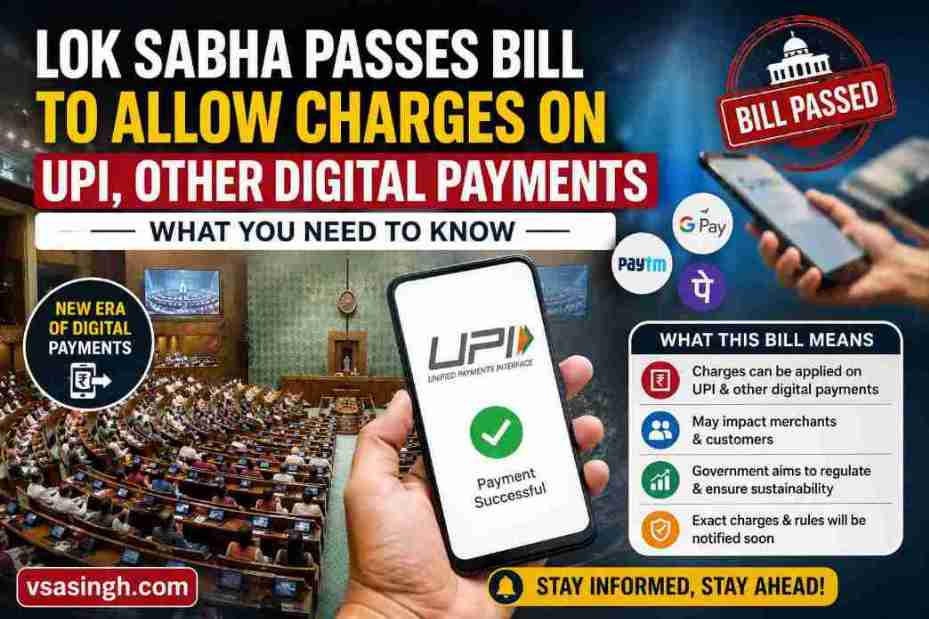
Does This Mean UPI Will No Longer Be Free?
No, not automatically.
The Lok Sabha’s approval does not mean that every person using UPI will immediately have to pay a transaction fee.
Instead, the amendment provides the legal basis for the government to permit charges under specified circumstances. The exact implementation, including which transactions could attract charges and who would pay them, would depend on subsequent policy decisions and applicable rules.
Therefore, if you currently use UPI to:
- Send money to family members
- Pay a friend
- Pay a small shop
- Buy everyday household items
- Pay utility bills
- Make ordinary digital payments
you should not interpret today’s development as an immediate blanket UPI fee.
The important change is that the legal restriction that previously prevented certain charges can now be altered.
The Genesis of India’s Digital Payment Revolution
To understand the regulatory framework governing digital transactions today, it is essential to look at how India transformed into a global leader in real-time retail payments.
The National Payments Corporation of India (NPCI) launched UPI Charges in 2016. By linking bank accounts directly to mobile applications via Virtual Payment Addresses (VPAs), UPI simplified peer-to-peer (P2P) and peer-to-merchant (P2M) transfers. The government’s push toward a less-cash economy—backed by demonetization, digital literacy campaigns, and zero-MDR mandates—accelerated UPI Charges adoption exponentially.
Key Milestones in UPI Adoption:
- Zero-MDR Policy (2020): The Government of India mandated a zero Merchant Discount Rate (MDR) on UPI and RuPay debit card transactions, meaning merchants paid zero fees to accept digital payments.
- Widespread Merchant Integration: Small, Medium, and Micro Enterprises (MSMEs) adopted QR code technology at an unprecedented rate due to zero transaction costs.
- Volume Growth: Real-time digital payment volumes in India surpassed combined transaction volumes of several major economies worldwide.
Understanding Digital Payment Regulations and Legislative Frameworks
Payment systems in India are primarily governed by the Payment and Settlement Systems Act, 2007 (PSS Act), along with periodic notifications and frameworks issued by the Reserve Bank of India (RBI) and the Ministry of Finance.
Legislative debates in the Lok Sabha regarding financial technology, payment infrastructure, and banking regulations periodically address the long-term viability of maintaining zero fees on large-scale payment networks.
The Role of the Payment and Settlement Systems Act
The PSS Act grants the Reserve Bank of India explicit authority to regulate, supervise, and lay down standards for payment systems operating within the country. UPI Charges Any bill, amendment, or regulatory update presented in Parliament regarding digital transactions generally focuses on three main objectives:
- Consumer Protection and Data Security: Ensuring robust encryption, fraud prevention, and strict data localization standards.
- Financial System Stability: Ensuring that payment system providers, acquiring banks, and switch operators remain financially viable.
- Innovation and Infrastructure Support: Creating frameworks that allow fintech start-ups to innovate while maintaining systemic security.
The Core Controversy: The Zero-MDR Model vs. Financial Sustainability
While the zero-MDR policy was instrumental in building India’s digital payment habit, it created a structural economic challenge for banks and fintech companies.
What is Merchant Discount Rate (MDR)?
Merchant Discount Rate is the fee charged to a merchant by the bank accepting digital payments. This fee covers the operational costs of processing the transaction, maintaining secure servers, upgrading infrastructure, and compensating various intermediaries in the payment chain:
- Issuing Bank: The bank where the buyer holds an account.
- Acquiring Bank: The bank supplying the merchant’s QR code or Point of Sale (POS) machine.
- Payment Service Provider (PSP): Apps like Google Pay, PhonePe, Paytm, or BHIM.
- Payment Gateway & Switch Operators: Entities like NPCI facilitating the routing of financial messages.
[Customer] ---> [PSP App / Issuing Bank] ---> [NPCI Switch] ---> [Acquiring Bank] ---> [Merchant]
                                  \                                   /
                                   +--- Operations & Infrastructure --+
The Cost of Free Infrastructure
Processing billions of transactions requires massive server capacities, cybersecurity operations, dispute-resolution mechanisms, and continuous technological upgrades. Under the zero-MDR regime:
- Banks and fintech apps faced recurring operational losses on UPI Charges processing.
- The Ministry of Finance provided periodic budgetary subsidies to compensate banks for low-value UPI transactions, but industry stakeholders argued the subsidies were insufficient to cover overall operational and investment expenditures.
Debates on Transaction UPI Charges: Fact vs. Public Confusion
Over the years, rumors and policy proposals regarding transaction charges on digital payments have frequently triggered widespread confusion. It is vital to distinguish between policy discussions, merchant interchange frameworks, and consumer charges.
A. Consumer Payments vs. Merchant Charges
In any payment network discussion, a fundamental distinction exists between P2P (Person-to-Person) and P2M (Person-to-Merchant) transactions:
| Transaction Type | P2P (Friend to Friend) | P2M (Customer to Business) |
| Primary Mechanism | Account-to-Account Transfer | QR Code scanning or online checkout |
| Policy Stance | Consistently Free for End-Users | Subject to discussions on Merchant Discount Rates |
| Impact of Fees | No charges levied on consumers | Fees (if applicable) are paid by businesses, not shoppers |
B. The Prepaid Payment Instruments (PPI) Interchange Framework
A prime example of regulatory adaptation occurred when NPCI introduced an interchange fee framework for transactions conducted using Prepaid Payment Instruments (PPI)—such as mobile wallets—for merchant payments above specific thresholds (e.g., ₹2,000). UPI Charges
Key aspects of this policy included:
- Zero Impact on Regular UPI: Normal bank-account-to-bank-account transfers via UPI remained completely free.
- Merchant-Side Adjustment: The fee applied only to wallet-based merchant transactions, paid by the merchant accepting the wallet payment, not the individual user.
Potential Impact of Charges on the Digital Ecosystem
If legislative amendments or regulatory updates eventually permit controlled, tiered charges or reintroduce MDR on specific high-value digital payments, the impact will resonate across different segments of the economy.
1. For Small Merchants and Kirana Stores
- Cost Sensitivities: Micro-merchants operating on slim margins are sensitive to transaction fees. Retaining zero or near-zero MDR for micro-transactions (e.g., transactions below ₹1,000 or ₹2,000) is widely considered essential to prevent merchants from shifting back to cash.
- Tiered Structures: Policy experts advocate for tiered fee structures where micro-merchants remain exempt, while large retail chains or corporate merchants absorb standard processing fees similar to credit card networks.
2. For Fintech Companies and Banks
- Monetization and Revenue Generation: Permitting reasonable merchant fees creates a sustainable business model for fintech platforms.
- R&D and Cybersecurity: Increased revenue enables financial institutions to invest heavily in advanced fraud detection, biometric authentication, and next-generation server infrastructure to reduce transaction failure rates.
3. For Everyday Consumers
- Free Basic Usage: Core banking transactions and everyday peer-to-peer transfers are designed to stay free to encourage digital inclusion.
- Enhanced Service Reliability: Better funded infrastructure translates to fewer server downtime incidents, faster refund processing, and improved customer support channels.
Global Comparisons: How Other Nations Handle Digital Payment Fees
India’s approach to real-time digital payment pricing is unique when compared to other global payment networks.
+-----------------------------------------------------------------------+
|                       GLOBAL PAYMENT NETWORKS                         |
+-----------------------------------++----------------------------------+
|      India (UPI)                  ||     International (Cards/Fast)   |
|  * Account-to-Account Real-Time   ||  * Credit & Debit Card Networks  |
|  * Zero/Subsidized MDR Policy     ||  * Standard MDR (1.5% - 3.0%)    |
|  * Driven by Financial Inclusion  ||  * Driven by Commercial Entities |
+-----------------------------------++----------------------------------+
United States & Europe
In Western markets, payment systems are largely dominated by private credit and debit card networks (such as Visa and Mastercard). These networks charge merchants transaction fees ranging between 1.5% and 3.5%. European regulators have capped interchange fees, but merchant transaction processing remains a commercial, revenue-generating service.
Brazil (Pix)
Brazil’s central bank introduced Pix, a real-time payment system similar to UPI. Pix is free for individual peer-to-peer transfers, but financial institutions are legally allowed to charge fees to corporate entities and merchants accepting payments. This hybrid model balances public adoption with commercial sustainability.
Strategic Recommendations for Business Owners and Digital Users
As digital payment policies, tax rules, and regulatory frameworks evolve, businesses and individual users should adopt smart financial habits to navigate the changing landscape efficiently.
For Merchants and Business Owners
- Understand Fee Breakdowns: Differentiate between direct bank transfers, credit card payments, and wallet payments to optimize checkout options for customers.
- Leverage Official Merchant Accounts: Use authorized business UPI accounts rather than personal VPAs to ensure compliance with tax guidelines and accounting standards.
- Optimize Payment Gateways: Choose payment gateway partners that offer transparent reporting, low processing overheads, and automated reconciliation features.
For Digital Consumers
- Maintain Digital Hygiene: Use multi-factor authentication, set daily transaction limits on payment apps, and never share OTPs or UPI PINs.
- Verify Payment Sources: Ensure that merchant QR codes display the correct business name before approving any transaction.
- Stay Updated via Official Channels: Always cross-check headlines regarding transaction fees, tax rules, or legislative bills against official releases from the Reserve Bank of India (RBI), Ministry of Finance, or NPCI.
Conclusion: The Road Ahead for India’s Fintech Landscape
The ongoing legislative and policy discourse around digital payment charges highlights the delicate balance required between promoting mass digital inclusion and maintaining financial self-sustainability.
While public interest in parliamentary proceedings and payment bills remains high, the core objective of India’s payment roadmap remains unchanged: delivering fast, secure, accessible, and affordable digital transactions for every citizen. As technology evolves, regulatory frameworks will continue to adapt to ensure that India’s digital payment ecosystem remains resilient, innovative, and globally leading.
For more in-depth analyses on finance, policy updates, technology trends, and digital economy insights, visit vsasingh.com.





Leave a Reply